Samuel Beckett in Confinement: the Politics of Closed Space by James Little
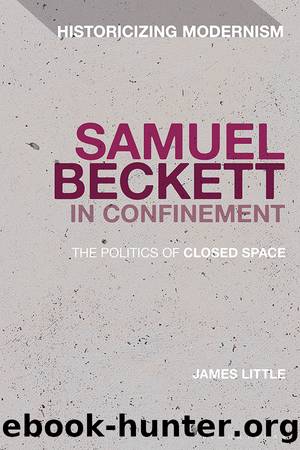
Author:James Little
Language: eng
Format: epub
Publisher: Bloomsbury Publishing
âFrom self estrangedâ: Learning to say âIâ
As is the case with Beckettâs decision to write in French, his move from the predominantly third-person narratives of the prewar prose to the first-person narrators of the postwar prose is not a clear-cut shift but more âa series of blurry zigzagsâ (Slote 2015: 114). In other words, Beckettâs use of the first-person pronoun needs to be understood in terms of a gradual learning process during the 1930s and 1940s: a process which included experiments with the first person in prose work such as âDing-Dongâ and Watt, poems such as the collection Echoâs Bones and Other Precipitates (1935), the âPetit Sotâ poems (written 1938â9) and âMatch Nul ou LâAmour Paisibleâ (written 1938) as well as in his diaries, letters and essays. Before discussing an early example, in âSerena Iâ, of a pronominal form which plays an important role in The Unnamableâs later denarration of the first-person narrative voice, I will focus on a selection of Beckettâs poetry, paying particular attention to the use of the first person in the âPetit Sotâ collection, the pronominal idiosyncrasies of his translations of Guillaume Apollinaireâs âZoneâ (1912; Beckettâs translation 1950) and the differing valences of translated pronouns in Beckettâs âthey comeâ (1946).
The so-called âPetit Sotâ collection is a series of remarkably unusual efforts to say âIâ.5 There is one long poem entitled âles joues rougesâ, which Beckett described as one of two âstraightforward descriptive poems (in French), of episodes in the life of a childâ (SB to TM, 18 April 1939, LSB I: 657).6 While âles joues rougesâ describes the hatred felt by the âPetit Sotâ [little fool] from a third-person perspective (qtd in Atik 2001: 10), there are also twenty-one shorter poems which are written from this figureâs own point of view. Sixteen start with the first-person pronoun and four â very unusually for Beckettâs poetry â open with the phrase âje suisâ [I am] (UoR MS 5479: 258â63).7 These shorter poems are declarative rather than purely descriptive, with the figure of the âPetit Sotâ a crucial, shifting lens through which the rest of the world is imagined. As Beckettâs use of the image of the âwombtombâ in his prose of the 1930s demonstrates, images of confinement are central to the self-estrangement of his early protagonists. Confinement is also found in his poetry. Recalling Belacquaâs self-made judas hole in Dream, the speaker of âLe Grenierâ stays close in his attic to a âhublotâ [deadlight], retreating into a space where â[p]ersonne ne me trouveraâ [no one will find me] (UoR MS 5479: 261).8 This use of an aperture of minimal size also recalls Beckettâs attempt to create âlight in the monadâ in Murphy, but in âLe Grenierâ the perspective has shifted and, in this first-person description of â2 placesâ, light comes from without to the speaker confined within his hiding place.
This shift towards a homodiegetic first-person narrative in a confined space was also central to the composition of Watt during the wartime years. However, the effort to say âIâ in Beckettâs poetry did not last for long after the war.
Download
This site does not store any files on its server. We only index and link to content provided by other sites. Please contact the content providers to delete copyright contents if any and email us, we'll remove relevant links or contents immediately.
4 3 2 1: A Novel by Paul Auster(12405)
The handmaid's tale by Margaret Atwood(7773)
Giovanni's Room by James Baldwin(7354)
Big Magic: Creative Living Beyond Fear by Elizabeth Gilbert(5780)
Asking the Right Questions: A Guide to Critical Thinking by M. Neil Browne & Stuart M. Keeley(5779)
Ego Is the Enemy by Ryan Holiday(5456)
The Body: A Guide for Occupants by Bill Bryson(5104)
On Writing A Memoir of the Craft by Stephen King(4948)
Ken Follett - World without end by Ken Follett(4740)
Adulting by Kelly Williams Brown(4582)
Bluets by Maggie Nelson(4566)
Eat That Frog! by Brian Tracy(4547)
Guilty Pleasures by Laurell K Hamilton(4455)
The Poetry of Pablo Neruda by Pablo Neruda(4113)
Alive: The Story of the Andes Survivors by Piers Paul Read(4037)
White Noise - A Novel by Don DeLillo(4019)
Fingerprints of the Gods by Graham Hancock(4009)
The Book of Joy by Dalai Lama(3996)
The Bookshop by Penelope Fitzgerald(3857)
